PoE Switch vs Normal Switch: Do You Actually Need PoE?
Confused about PoE switch power budget? Here's a simple way to calculate how many cameras or access points your switch can actually run, with real examples.
Shopping for a network switch and suddenly seeing "PoE" attached to half the listings, with no clear sense of whether you need it? You're not alone — this is one of the most common points of confusion for anyone buying networking gear for the first time, whether it's for a home office, a small business, or a CCTV installation.
The good news is that the decision is genuinely simple once you know what to check. Here's exactly how to tell which one you need.
The One-Sentence Difference
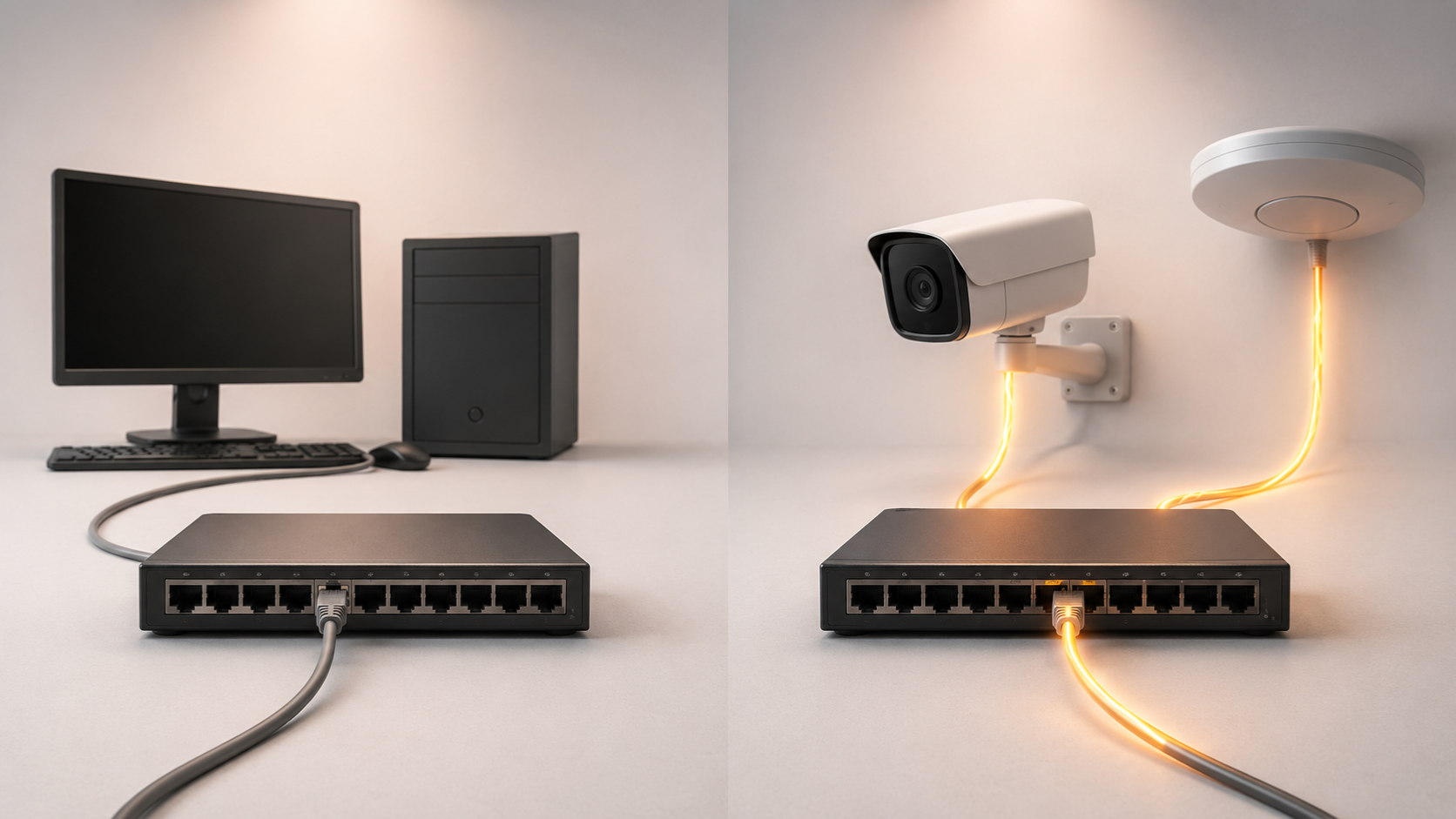
A normal switch only moves data between connected devices. A PoE switch does that too, but also sends electrical power through the same Ethernet cable — meaning PoE-compatible devices don't need a separate power adapter or wall socket at all.
That's really the entire distinction. Everything else — price, use cases, which one to buy — flows from that one difference.
What a Normal Switch Handles Well
A normal (non-PoE) switch, like the Tenda S105 or S108, connects and expands your wired network for devices that already have their own power source:
- Desktop computers and laptops (plugged into their own charger/power supply)
- Printers
- Smart TVs, gaming consoles, streaming boxes
- NAS drives
- Any device with a standard wall-plug power adapter
If everything you're connecting already powers itself independently, a normal switch does the job perfectly well, and typically costs noticeably less than an equivalent PoE model — you're not paying for power-delivery hardware you won't use.
What Actually Needs a PoE Switch
PoE switches exist specifically for devices designed to receive power over the Ethernet cable itself, rather than through a separate adapter:
- IP security cameras — almost universally PoE-powered in modern CCTV installations
- WiFi access points — especially ceiling or wall-mounted units where running a separate power socket would mean unsightly cabling or an electrician
- VoIP phones — common in offices, where PoE avoids a power brick at every desk
- Access control devices — door readers, intercoms, and similar systems
The appeal here isn't just convenience — it's often a genuine installation requirement. A ceiling-mounted access point or an outdoor camera frequently goes in a location with no nearby power outlet at all. Running electrical wiring to that spot can mean hiring an electrician and cutting into walls or ceilings. A single Ethernet cable from a PoE switch solves both power and data in one run.
The Simple Decision Test
Ask yourself one question about what you're actually connecting: does it come with its own power adapter, or does it expect to be powered through the network cable?
- Own power adapter (computers, printers, smart TVs) → Normal switch is all you need
- No separate power input, PoE-designed (IP cameras, access points, VoIP phones) → You need a PoE switch
- A mix of both → A PoE switch handles this fine — PoE ports work perfectly well with non-PoE devices too, they simply won't send power to them. You lose nothing by using a PoE switch for a mixed setup, other than paying somewhat more upfront.
This last point trips people up more than any other: a PoE switch is always backward-compatible with regular, non-PoE devices. You never need to worry about "damaging" a normal device by plugging it into a PoE port — the switch only sends power to devices that specifically request it during a detection process. If your network has both types of devices, buying a PoE switch for the whole setup is a perfectly safe, common choice.
What About Cost?
PoE switches cost more than equivalent non-PoE models, because they include additional power-delivery hardware internally. This isn't a marketing markup — it's a real difference in what's inside the unit. The decision on whether that's worth it comes down to what you're actually powering:
- If you have zero PoE devices currently, and don't plan to add any (cameras, access points), a normal switch is the more cost-effective, sensible choice
- If you have even one or two PoE devices now, or expect to add a camera or access point later, a PoE switch often ends up cheaper overall than buying a normal switch now and a separate PoE injector for each device later
- If you're setting up a CCTV system or multiple access points from the start, a PoE switch is virtually always the right call — trying to power multiple cameras with individual injectors quickly becomes messier and more expensive than one PoE switch
A Common Follow-Up Question: Can I Add PoE Later Without Replacing My Switch?
If you already own a normal switch and later want to add one or two PoE devices, you don't necessarily need to replace the whole switch. A PoE injector — a small standalone device — can add PoE capability to a single Ethernet run without needing a PoE switch at all. This is a sensible stopgap for one or two devices, though it becomes less practical and more expensive per-device than a PoE switch once you're powering more than a handful of devices.
Frequently Asked Questions
Will a PoE switch damage a device that doesn't support PoE? No. PoE switches perform a detection process before sending power to any port — they only deliver power to devices that specifically identify themselves as PoE-compatible. Regular devices connected to a PoE port simply receive data, exactly as they would from a normal switch.
Is it worth buying a PoE switch even if I only have one camera right now? It depends on your plans. If you expect to add more cameras or access points over time, a PoE switch is often the more future-proof choice. If you're certain you'll only ever have that one device, a single PoE injector paired with a normal switch can be a cheaper solution for now.
Do I need a PoE switch for a WiFi access point? Most modern access points, especially ceiling or wall-mounted models, are designed to be PoE-powered, which avoids running separate electrical wiring to the mounting location. Check your specific access point's power requirements — some support both PoE and a standard power adapter as options.
What's the difference between a PoE switch and a PoE injector? A PoE switch has multiple PoE-enabled ports built in, suited to powering several devices from one central point. A PoE injector adds PoE capability to a single existing Ethernet connection, typically used for one device at a time or as an add-on to a switch that doesn't have PoE.
Can I mix PoE and non-PoE devices on the same PoE switch? Yes, without any issue. A PoE switch works perfectly well as a normal switch for non-PoE devices connected to it — it simply won't send power to those specific ports, since the devices don't request it.
Do PoE switches use significantly more electricity than normal switches? A PoE switch's own power draw is somewhat higher than a normal switch, partly due to internal power delivery components and partly due to the actual power being sent to connected devices. For most home and small office setups, this difference is minor compared to the convenience and installation savings PoE provides.
Whether you need PoE comes down entirely to what you're connecting, not how advanced your network needs to be. Browse Tenda's PoE switches and standard network switches — both PoE and standard models — to find the right fit for your setup.