Single Band vs Dual Band Router: Which One Should You Buy?
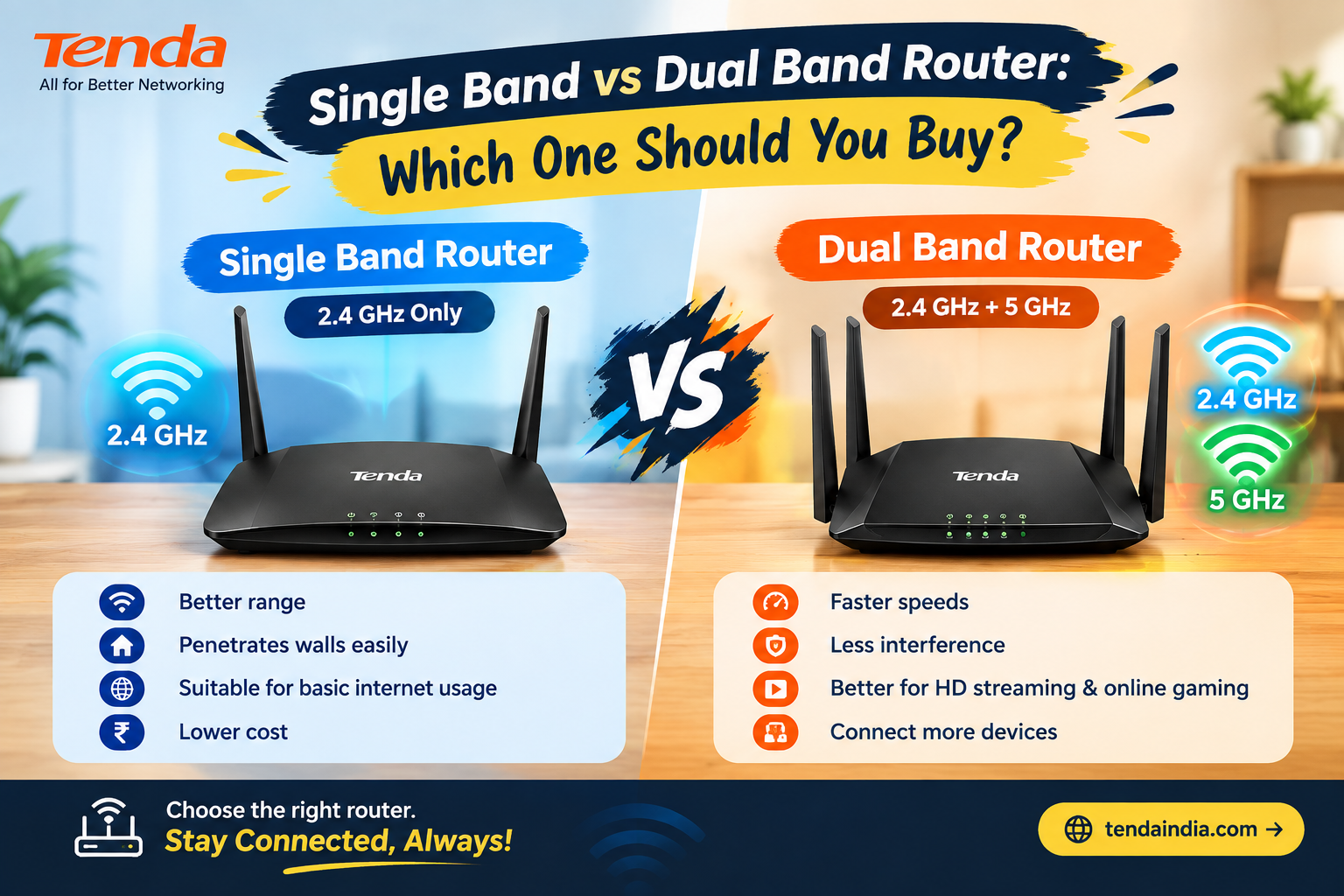
Confused between single band and dual band routers? Compare speed, range, and interference to find the right fit for your home or office network.
Single Band vs Dual Band Router: Which One Should You Buy?
If your Wi-Fi feels sluggish the moment more than a couple of devices connect, or the signal turns unreliable in certain rooms, the type of router you're using has a lot to do with it. Two terms come up constantly in this conversation: single band and dual band. Understanding the real difference not just the marketing language makes it much easier to choose the right router for your home or office.
What Is a Single Band Router?
A single band router broadcasts on only one wireless frequency: 2.4 GHz. This frequency has been the backbone of home Wi-Fi for years, and it still has real strengths.
Where it performs well:
- Longer range and better wall penetration, since lower frequencies travel through solid objects more easily
- A lower cost, making it a practical entry point for smaller households
- Sufficient for everyday tasks like browsing, messaging, video calls, and standard-definition streaming
Where it falls short:
- Slower maximum speeds compared to higher frequencies
- More prone to interference and congestion, since 2.4 GHz is shared by cordless phones, microwaves, Bluetooth devices, and often every neighboring Wi-Fi network within range
- Performance drops noticeably once several devices are connected and active at the same time
What Is a Dual Band Router?
A dual band router broadcasts on two frequencies simultaneously: 2.4 GHz and 5 GHz. Devices connect to whichever band suits them best, either automatically through band-steering or by manual selection.
Where it performs well:
- Significantly faster speeds on the 5 GHz band ideal for streaming, gaming, and large file transfers
- Reduced congestion, since 5 GHz is a far less crowded frequency than 2.4 GHz
- Better overall performance with many devices connected at once, since traffic is split across two bands instead of competing for one
Where it falls short:
- The 5 GHz band has a shorter range and struggles more with walls and floors, though the same router's 2.4 GHz band still covers the longer distance
- Typically sits at a higher price point than single band options
Single Band vs Dual Band: A Side-by-Side Look
| Single Band | Dual Band | |
| Frequency | 2.4 GHz only | 2.4 GHz + 5 GHz |
| Speed | Lower | Higher on 5 GHz |
| Range | Longer, better wall penetration | Shorter on 5 GHz; same 2.4 GHz range available |
| Interference | Higher a congested band | Lower 5 GHz is less crowded |
| Best for | Small spaces, light usage, budget setups | Multiple devices, streaming, gaming, larger homes or offices |
Which Is Best for You: Single Band or Dual Band?
The right choice comes down to how you actually use your network, not which option sounds more advanced.
A single band router is a solid choice if:
- You live in a smaller apartment with only a handful of connected devices
- Your internet plan itself is modest, so a faster band wouldn't be fully used anyway
- Your day-to-day usage is mostly browsing, messaging, and standard streaming
A dual band router is the better fit if:
- Your home or office regularly has many devices connected at once phones, laptops, smart TVs, security cameras, other smart devices
- You stream in HD or 4K, game online, or transfer large files often
- You've noticed your current network slowing down during peak hours
For most modern households and small offices, a dual band setup has become the more future-proof pick device counts keep climbing, and a single congested band shows its limits quickly. The best router for a growing household is rarely the cheapest one; it's the one that still performs once every device in the house is online at the same time.
Frequently Asked Questions
Is a dual-band router better than a single-band router?
For most users, yes a dual band router adds the flexibility of a fast, low-interference 5 GHz band alongside the long-range 2.4 GHz band. The exception is very light usage in a small space, where a single band router still performs perfectly well.
Which band is better, 2.4 GHz or 5 GHz?
Neither is universally "better" they suit different jobs. 2.4 GHz travels further and passes through walls more easily, which makes it better for range. 5 GHz is faster but covers less distance, which makes it better for high-bandwidth tasks at closer range.
Can I run both 2.4 GHz and 5 GHz at the same time?
Yes. A dual band router broadcasts both simultaneously, and most routers let devices connect to whichever band gives the best performance, either automatically or through manual selection.
Is a single band router good enough for a household?
It can be, for light usage and a small number of devices. Once streaming, gaming, or several simultaneously connected devices enter the picture, a single band router's one congested channel starts to show its limits.
Do I need a dual band router for my home?
If you have more than a handful of devices, stream video regularly, or work from home with frequent video calls, a dual band router is worth the difference in cost. For a small space with basic usage, single band remains a genuinely practical option.