Single Band vs Dual Band Router: Which One Should You Actually Buy?
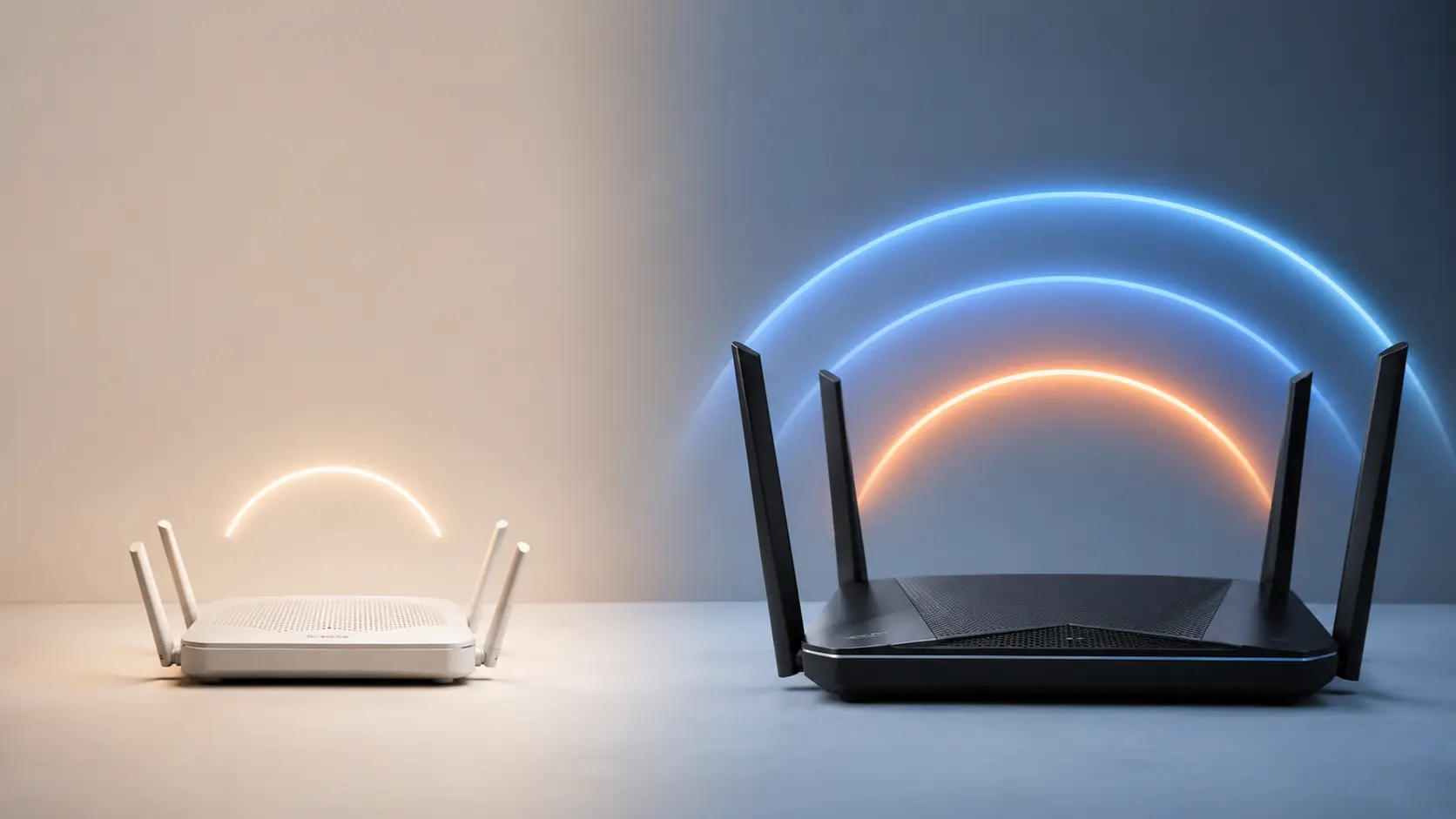
Confused between single band and dual band routers? Here's a simple, no-jargon explanation to help first-time buyers choose the right one in India.
If you're buying your first router — or replacing the free one your ISP gave you years ago — you've probably run into the terms "single band" and "dual band" without a clear explanation of what they actually mean for your day-to-day internet. It sounds technical, but the idea behind it is simple once it's explained properly. This guide breaks it down in plain language so you can make the right call for your home, without needing to understand WiFi engineering.
What Does "Band" Even Mean?
Every WiFi router sends its signal over a radio frequency, measured in gigahertz (GHz). Think of these frequencies like radio stations — different "bands" carry the signal differently, with trade-offs between range and speed.
- 2.4 GHz — travels further and passes through walls more easily, but is slower and gets more crowded, since most household gadgets (microwaves, cordless phones, other WiFi networks in nearby flats) also use this frequency
- 5 GHz — significantly faster, but the signal doesn't travel as far or pass through walls as effectively
A single-band router only broadcasts on 2.4 GHz. A dual-band router broadcasts on both 2.4 GHz and 5 GHz at the same time, letting your devices automatically connect to whichever works better for them.
Single-Band Routers: What You Get
Single-band routers, like the Tenda F3 or N301, operate purely on the 2.4 GHz frequency, with speeds typically up to 300 Mbps.
Where single-band works well:
- Small apartments or single rooms
- Basic browsing, email, messaging, and standard-definition video
- Budget broadband plans under 50 Mbps
- Homes with only a handful of connected devices
Where it starts to struggle:
- Apartment buildings with many neighbouring WiFi networks, since 2.4 GHz is crowded and prone to interference
- HD or 4K streaming across multiple devices at once
- Households with 8 or more connected gadgets competing for the same limited bandwidth
Imagine a narrow single-lane road that everyone in the neighbourhood shares. It works fine when traffic is light, but the moment several vehicles need to pass at once, things slow down — that's essentially what happens to 2.4 GHz in a densely populated building with dozens of WiFi networks stacked on the same frequency.
Dual-Band Routers: What You Get
Dual-band routers, like the Tenda AC5 or AC10, broadcast on both 2.4 GHz and 5 GHz simultaneously. An AC1200 dual-band router delivers combined speeds up to 1200 Mbps (roughly 867 Mbps on 5 GHz plus 300 Mbps on 2.4 GHz).
Where dual-band earns its higher price:
- Homes with multiple devices — phones, laptops, smart TVs — all connected at once
- HD and 4K streaming, video calls, and online gaming, which benefit from 5 GHz's speed
- Apartment buildings where 2.4 GHz congestion from neighbouring networks is a real problem
- Fibre broadband plans of 100 Mbps or higher, where you actually want the extra headroom 5 GHz provides
The router automatically decides which band suits each device — your smart TV in the next room might connect over 2.4 GHz for range, while your laptop sitting close by connects over 5 GHz for speed. You don't need to manage this manually; it happens in the background.
Side-by-Side Comparison
| Single-Band (2.4 GHz only) | Dual-Band (2.4 GHz + 5 GHz) | |
|---|---|---|
| Max combined speed | Up to 300 Mbps | Up to 1200 Mbps (AC1200) |
| Range | Better through walls | Shorter range on 5 GHz, but 2.4 GHz still available |
| Interference | More prone to congestion | Less crowded 5 GHz option |
| Best for | Small homes, basic use | Multi-device homes, streaming, gaming |
| Typical price | Lower | Moderate, still budget-friendly |
| Example Tenda models | F3, N301 | AC5, AC10 |
How to Decide: Three Quick Questions
1. How many devices connect to your WiFi at once? Under 5 devices doing basic tasks → single-band is often enough. More than that, especially with streaming or gaming → dual-band pays off quickly.
2. Do you live in an apartment building? If you're surrounded by dozens of other WiFi networks, 2.4 GHz congestion is a real issue single-band can't avoid. Dual-band's 5 GHz option gives you a cleaner, less crowded lane.
3. What's your broadband plan speed? If your plan is under 50 Mbps, a single-band router won't bottleneck you much. If you're on 100 Mbps or higher, a single-band router's 300 Mbps ceiling becomes a real limitation, especially with more than one device active.
Here's the thing most first-time buyers get wrong: they assume single-band is simply the "cheap, worse" option and dual-band is always better. That's not quite right — single-band genuinely is the smarter buy for a small household with light, basic usage. Paying extra for 5 GHz capacity you'll never fully use isn't "better," it's just spending more for headroom you don't need.
Frequently Asked Questions
Is a dual-band router always better than single-band?
Not necessarily "better" — it depends on your usage. Dual-band is the better choice for multi-device homes, HD streaming, and apartment buildings with WiFi congestion. For a small household with basic browsing needs, single-band is a perfectly capable, more affordable option.
Can all devices connect to a 5 GHz network?
Most modern smartphones, laptops, and smart TVs support 5 GHz, but some older or budget devices only support 2.4 GHz. Dual-band routers handle this automatically — 5 GHz-capable devices connect to that band, while older devices fall back to 2.4 GHz on the same router.
Does 5 GHz have less range than 2.4 GHz?
Yes. 5 GHz signals don't travel as far or pass through walls as effectively as 2.4 GHz. This is exactly why dual-band routers broadcast both bands — you get 5 GHz's speed nearby and 2.4 GHz's range farther away, without needing a separate router for each.
Will upgrading from single-band to dual-band increase my internet speed beyond my broadband plan?
No. A router can't exceed the speed your ISP provides. What it can do is make sure you're not losing speed to router limitations — a single-band router capped at 300 Mbps would bottleneck a 200 Mbps plan, while a dual-band router wouldn't.
Is a single-band router still worth buying in 2026?
Yes, for the right household. If you have a small home, a modest broadband plan, and basic internet needs, a single-band router like the Tenda F3 remains a genuinely good-value option — not everyone needs dual-band capacity.
Neither option is universally "the right one" — the right router is the one that matches how your household actually uses the internet. Browse Tenda's single-band and dual-band router range to compare models side by side and find the fit for your home.