4 Port vs 8 Port vs 16 Port PoE Switch: How to Choose the Right Size
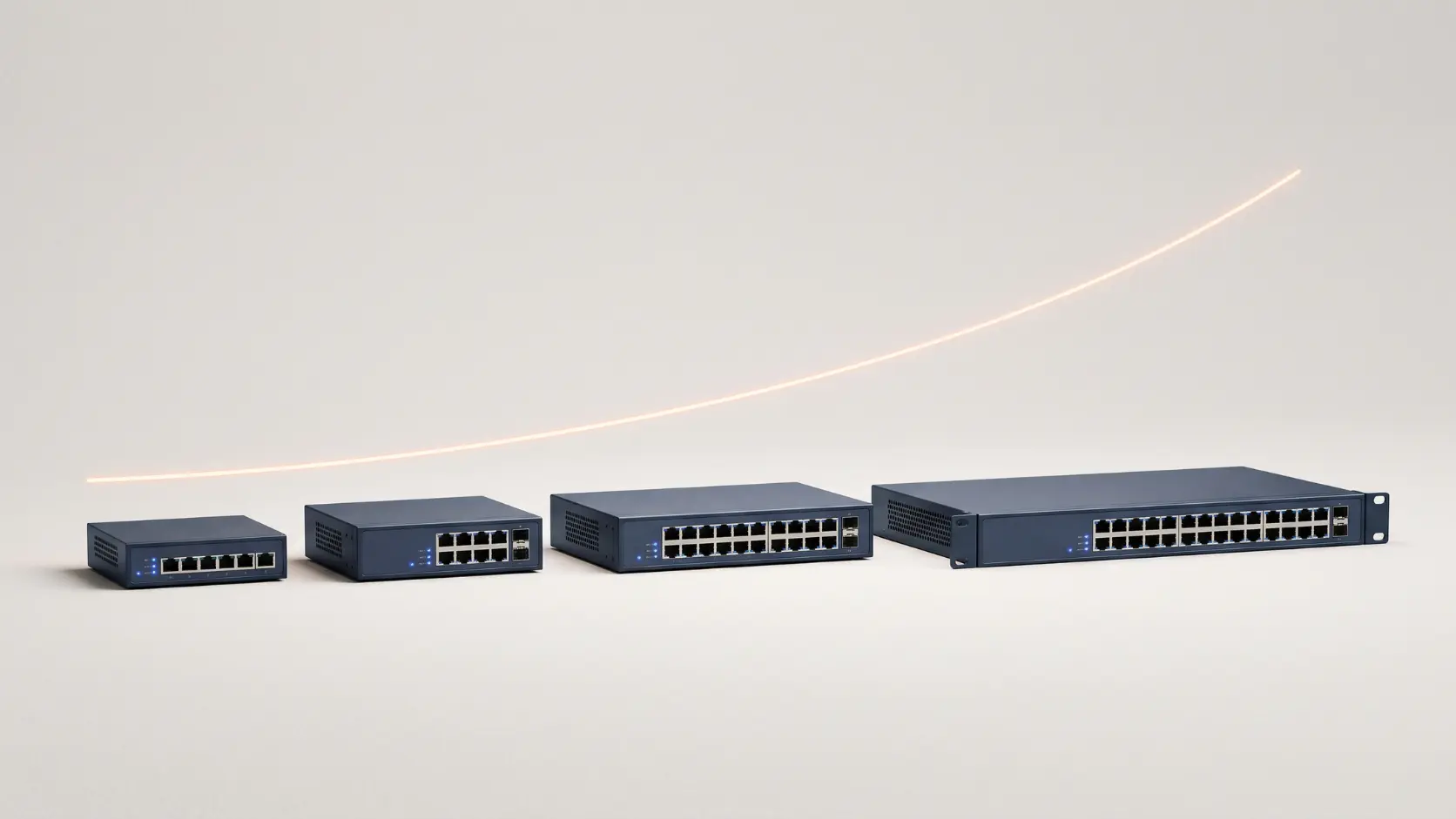
4, 8, 16 or 24 ports? Port count alone can mislead. Match your cameras and access points to real PoE watts, with a Tenda model for each size.
Most people shop for a PoE switch the way they shop for a power strip: count the sockets, buy the one with enough. Eight cameras, eight ports, done.
It doesn't quite work like that. A PoE switch has two limits, and the one that runs out first is usually not the ports. It's the watts. An 8-port switch that can only supply 75W of PoE power can't run eight night-vision cameras, however many sockets it has. The cameras that don't fit simply won't power on, or they'll drop out the first night the infrared kicks in.
This guide helps you pick the right size using both numbers, with the real PoE figures for every Tenda model, so you don't buy a switch that has the ports but not the power.
The Two Numbers That Decide Everything
1. Ports. How many devices can physically plug in.
2. Usable PoE power. The total watts the switch can deliver to all its PoE ports at the same time. This is shared across the ports, not given to each one.
Every PoE port on Tenda's range delivers up to 30W (802.3at), so a single camera is never the problem. The total is. If you want the full explanation, our PoE power budget guide covers it in detail.
One more thing that trips people up: some Tenda model names include a wattage, such as "-150W", "-250W" or "-410W". That number is the power supply rating of the whole unit, not the PoE power available for your devices. The usable PoE figure is lower, and it's the one to size against.
Tenda's PoE Switches at a Glance
| Model | PoE ports | Port speed | Usable PoE power | Notes |
|---|---|---|---|---|
| S106PC | 4 | 100M | about 50W (55W for the whole unit) | 6 ports in total, 250m Extend mode |
| SG106PC | 4 | Gigabit | about 50W (55W for the whole unit) | 6 ports in total |
| S110PC | 8 | 100M | 75W (80W for the whole unit) | 10 ports in total, 250m Extend mode |
| SG110PC | 8 | Gigabit | 95W (100W for the whole unit) | 10 ports in total |
| TEF1118P-16-150W | 16 | 100M | up to 135W (150W supply) | 2 Gigabit uplinks and an SFP, rack or desktop |
| TEG1120P-16-250W | 16 | Gigabit | about 230W (250W supply) | 2 Gigabit uplinks and 2 SFP |
| TEG1128P-24-410W | 24 | Gigabit | 370W (410W supply) | 2 Gigabit uplinks and 2 SFP, 1U rack |
All of them are unmanaged, so they work the moment you plug them in, with no setup screens.
How Many Cameras Can Each One Really Power?
Here's the table most buyers never get to see. It shows how many cameras each switch can power with a sensible 25 percent safety buffer for night-time infrared spikes, limited by both power and port count.
| Model | Cameras at 6W each | at 9W each | at 12W each | at 15W each |
|---|---|---|---|---|
| S106PC / SG106PC | 4 | 4 | 3 | 2 |
| S110PC | 8 | 6 | 5 | 4 |
| SG110PC | 8 | 8 | 6 | 5 |
| TEF1118P-16-150W | 16 | 12 | 9 | 7 |
| TEG1120P-16-250W | 16 | 16 | 15 | 12 |
| TEG1128P-24-410W | 24 | 24 | 24 | 19 |
Read it across. An S110PC has 8 PoE ports, but at 9W per camera it comfortably handles 6, not 8. The SG110PC, with its 95W, handles all 8. Same ports, different power, and that's exactly the difference the box doesn't tell you.
Camera power draw varies by model, so check your own cameras' datasheets. Basic fixed cameras run around 4W to 7W, cameras with infrared night vision typically 6W to 12W, and PTZ cameras 15W to 30W or more.
4 Port PoE Switch: Small Shops and Compact Homes
Models: S106PC (100M) and SG106PC (Gigabit)
With about 50W of PoE power across 4 ports, this size fits a small, simple setup: a shop with three or four cameras, a home with a gate, a door and a rear entrance, or a couple of cameras plus an access point.
Where it works: four standard cameras at around 9W each need about 45W with a safety buffer, which fits.
Where it doesn't: four cameras at 12W need about 60W, which is over the limit. A single PTZ camera at 25W plus three standard cameras also goes over. If your cameras are on the higher-power side, or you expect to add more, go up a size.
Both have two extra non-PoE ports, so you can connect your recorder and the rest of your network without using up a PoE port.
8 Port PoE Switch: The Sweet Spot for Most Homes and Offices
Models: S110PC (100M, 75W) and SG110PC (Gigabit, 95W)
This is the most popular size for good reason. It covers a larger home, a small office, or a mix of cameras and access points, with room to grow.
The choice within this size is about power:
- The S110PC is the right fit for up to about 6 night-vision cameras, or a mix of 3 or 4 cameras and a couple of access points.
- The SG110PC handles all 8 ports with standard cameras and gives you more room if some cameras draw more.
The speed choice matters here too. The S110PC's uplink ports are 100M, and every camera's video travels through the uplink to your recorder. Eight 4MP cameras at around 8 Mbps each add up to about 64 Mbps, which fits in a 100M uplink but leaves little spare capacity. For higher-resolution cameras, or if the switch carries other traffic, the SG110PC's Gigabit ports are the better choice. Our CCTV bandwidth figures explain how to estimate camera bitrates.
For a full worked example of choosing between these two, see our guide to the best PoE switch for home CCTV.
16 Port PoE Switch: Larger Offices, Schools and Shops
Models: TEF1118P-16-150W (100M ports, up to 135W) and TEG1120P-16-250W (Gigabit ports, about 230W)
Once you pass about ten devices, a 16-port switch starts making sense, and the two models serve different needs:
- The TEF1118P-16-150W suits straightforward camera and access point deployments. At 9W per camera it powers about 12 cameras, and 9 at 12W. It has Gigabit uplinks, so the combined video traffic isn't squeezed.
- The TEG1120P-16-250W has Gigabit PoE ports and far more power, so it can fill all 16 ports with standard cameras and still have room, which makes it the better pick when higher-power devices like PTZ cameras or WiFi 6 access points are in the mix.
Both list Standard, VLAN, Priority and Extend operating modes, selectable on the switch itself.
24 Port PoE Switch: Full Buildings
Model: TEG1128P-24-410W (Gigabit, 370W)
The largest in the range is built for whole-building deployments: a school, a warehouse, a multi-floor office, or a large camera installation. With 370W of PoE power it powers all 24 ports with standard cameras and still has headroom. Even at 15W per device, it handles about 19.
At this scale, it often makes sense to plan the cabling and the rack layout together, and to keep spare capacity for future cameras.
Two Smaller Switches or One Bigger One?
If your cameras are split across two clusters, such as the front of a property and the rear, two 8-port switches near each cluster can be better than one 16-port switch in the middle. You save on cable, you shorten each run, and a problem with one switch doesn't take down every camera. You connect the two switches with a single cable between them.
If everything is in one place, one larger switch is usually simpler and easier to manage.
A Few Features Worth Checking
- Extend Mode. Several models (including the S106PC, S110PC and TEF1118P) can push a PoE run out to 250 metres on specific ports, at a reduced 10 Mbps on those ports. That's useful for a single distant camera. Our Extend Mode guide covers the trade-off.
- Lightning protection. Tenda lists 4KV port protection on the S110PC and SG110PC and 6KV on the TEF1118P, which is worth having in India's monsoon season. Check the datasheet of the model you're buying for its exact rating.
- Mounting. The smaller models mount on a desk or wall, and the larger ones suit a rack.
- Fanless design. Several models run silently, which matters if the switch sits in an office or a shop.
Quick Picks
| Your situation | Sensible choice |
|---|---|
| Small shop or home, 2 to 4 low-power cameras | S106PC |
| Same, but with higher-resolution cameras | SG106PC |
| Home or small office, up to about 6 cameras | S110PC |
| 7 to 8 cameras, or 4MP and above | SG110PC |
| Larger office or school, 10 to 12 cameras | TEF1118P-16-150W |
| 12 to 16 devices, PTZ cameras or WiFi 6 access points | TEG1120P-16-250W |
| 17 to 24 devices, or a whole building | TEG1128P-24-410W |
If you're between two sizes, take the larger one. Cameras get added far more often than they get removed.
Frequently Asked Questions
Can a 4 port PoE switch run 4 cameras?
Yes, if the cameras are low-power. Four standard cameras at around 9W each fit within the S106PC or SG106PC's roughly 50W. Four higher-draw cameras at 12W or more don't, so check your cameras' wattage.
Can an 8 port PoE switch run 8 cameras?
It depends on the switch. The SG110PC (95W) can run eight cameras at around 9W each. The S110PC (75W) comfortably handles about six, because its power runs out before its ports do.
What does the wattage in the model name mean?
In names like TEF1118P-16-150W, the number is the power supply rating of the whole unit. The PoE power available for devices is lower (up to 135W for that model), so size against the PoE figure on the product page.
Do I need a Gigabit PoE switch for CCTV?
For standard 2MP to 4MP cameras, 100M PoE ports are enough, since each camera uses only a few Mbps. Gigabit matters more for higher-resolution cameras, for busy networks, and where many cameras' video travels over one uplink to the recorder.
Can I mix cameras and access points on one switch?
Yes. Add up every device's wattage, include a buffer, and compare the total with the switch's PoE power. Our PoE power budget guide shows the arithmetic.
What happens if I connect more cameras than the switch can power?
Some won't power on, or they drop out at night when infrared raises their draw. Our PoE troubleshooting guide explains how to spot it.
Does my NVR already have PoE ports?
Many do, but they're often limited in number and power. A separate PoE switch is the usual answer when you have more cameras than the recorder's ports, or when cameras sit far from the recorder.
Choosing a PoE switch is mostly arithmetic: add up the watts, add a buffer, and match the result to the switch's real PoE power as well as its port count. Browse Tenda's PoE switch range to find the right size, or talk to our team if you'd like a second pair of eyes on your setup.